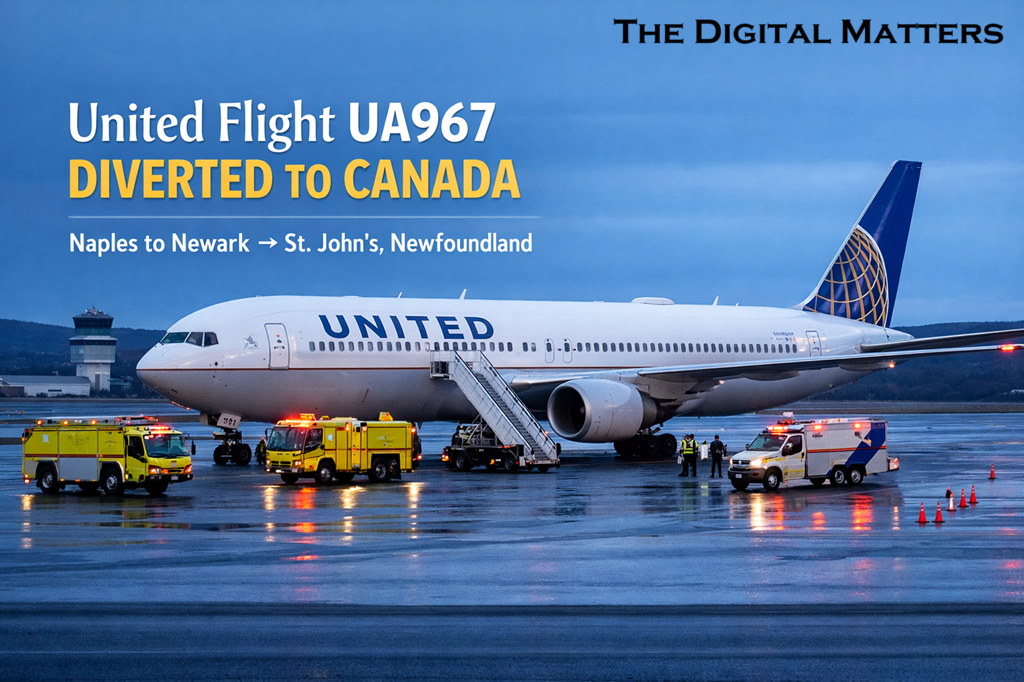
United Flight UA967, a scheduled transatlantic service from Naples Italy (NAP) to Newark New Jersey (EWR), diverted to St. John’s International Airport (YYT) in Newfoundland, Canada in late August 2025. The aircraft landed safely, and there were no injuries reported.
Before the diversion, UA967 was already running more than three hours late. During the North Atlantic crossing, the flight crew identified a safety concern that required an unscheduled landing in Canada rather than continuing to the United States.
Public information indicates the diversion followed standard aviation safety procedures, likely related to operational, technical, or environmental factors. While specific system level details were not released, the decision reflects precautionary risk management, not loss of control.
In commercial aviation, diversions like UA967 are designed to protect passengers by resolving uncertainty early, on the ground, and with full support services available.
What Is United Flight UA967?
United Flight UA967 is a regularly scheduled long haul international route operated by United Airlines. The flight connects southern Europe with the northeastern United States and routinely crosses the North Atlantic under international flight rules.
Key route details include:
- Departure airport: Naples International Airport
- Arrival airport: Newark Liberty International Airport
- Typical aircraft: Boeing 767 300ER
- Route type: Long haul transatlantic
Because of the distance involved, UA967 operates with enhanced diversion planning, alternate airports, and continuous operational monitoring.
The August 2025 Diversion: What Happened
Pre departure delay in Naples
On August 24, 2025, UA967 departed Naples later than scheduled. Reports indicated a delay exceeding three hours. Such delays on long haul flights often stem from weight and balance calculations, fuel planning, crew duty limits, or maintenance checks.
Although inconvenient, these steps ensure compliance with safety margins before departure.
Safety concern detected during the crossing
Several hours into the flight, the crew identified a condition that required caution. Passenger accounts and flight reports referenced a burning or unusual odor, potentially electrical in nature. Importantly, there were no confirmed flames, no visible smoke, and no injuries.
In aviation, unexplained odors are treated as significant because they can indicate electrical issues, system irregularities, or environmental control problems.
Decision to divert to Canada
Following established international procedures, the pilots chose to divert rather than continue across the Atlantic. This choice was deliberate and conservative, prioritizing certainty over schedule.
The aircraft rerouted to St. John’s International Airport, a primary diversion airport for transatlantic operations.
Why St. John’s Is a Key Transatlantic Diversion Airport
St. John’s International Airport plays a critical role in North Atlantic aviation safety planning.
Airlines regularly select YYT because it offers:
- Runways capable of handling wide body aircraft
- Full emergency response and fire services
- Aircraft inspection and maintenance capability
- Customs and immigration processing for international passengers
- Strategic location beneath major transatlantic flight paths
For westbound flights already over the ocean, St. John’s often represents the closest suitable airport with full operational support.
Was United Flight UA967 an Emergency
This distinction matters for clarity and trust.
What is confirmed
- The aircraft landed safely
- Emergency services were present as a precaution
- No injuries were reported
What is not confirmed
- No verified onboard fire
- No loss of aircraft control
While the crew may have declared an emergency to secure priority handling, the event aligns with preventive aviation decision making, not a crisis scenario.
What Passengers Experienced After the Diversion
After landing in Canada, standard international diversion procedures were followed.
Passengers typically experienced:
- A calm, controlled landing
- Clear communication from pilots and cabin crew
- Time on the ground for inspection and clearance
- Rebooking, accommodation, or onward travel arrangements
Although delays can be frustrating, these steps exist to ensure that any uncertainty is fully resolved before the aircraft continues.
Passenger Rights and Compensation Considerations
Because UA967 departed from the European Union, some passengers may have been eligible for protections under EU Regulation EC 261 2004, depending on the cause of the diversion.
Possible considerations include:
- Hotel accommodation and meals if an overnight stay occurred
- Rebooking assistance to Newark or an alternate destination
- Compensation eligibility, which depends on whether the cause was within the airline’s control, such as a mechanical issue, versus extraordinary circumstances like weather
Passengers are typically advised to check directly with United Airlines or trusted booking platforms for case specific guidance.
Other UA967 Incidents and Why Context Matters
Flight numbers are reused across years, aircraft, and routes. That can create confusion.
Important context:
- A 2010 severe turbulence incident associated with UA967 involved a different route and aircraft
- Reported diversions in 2024 and July 2025 involved unrelated operational or weather factors
- Each event occurred under different circumstances
Sharing a flight number does not imply a repeated safety issue.
What Happens After a Transatlantic Diversion
Once a flight diverts, it does not resume service immediately.
Standard post diversion steps include:
- Full mechanical and electrical inspection
- Maintenance documentation and diagnostics
- Regulatory and operational clearance
- Crew duty time evaluation
- Passenger rebooking and accommodation planning
These steps confirm that every potential risk is resolved before the aircraft returns to service.
Why the UA967 Diversion Shows the System Working
Diversions can feel disruptive. However, they represent one of aviation’s strongest safety tools.
The UA967 diversion demonstrates:
- Crew training that prioritizes caution
- Airline policies that support conservative decisions
- Effective coordination between international airports
- A safety culture that values outcomes over schedules
The best safety outcomes are the ones that never become dramatic.
Final Perspective on United Flight UA967 Diverted
United Flight UA967 diverted because uncertainty was taken seriously. The aircraft landed safely in Canada, passengers were protected, and the situation remained controlled from start to finish.
In modern aviation, arriving later is always better than pressing forward without full confidence. UA967 stands as a clear example of how aviation safety systems work exactly as intended.
FAQs About United Flight UA967 Diverted
Why was United Flight UA967 diverted?
The flight diverted due to a precautionary operational or safety concern detected during the transatlantic crossing.
Where did United Flight UA967 land?
UA967 landed safely at St. John’s International Airport in Newfoundland, Canada.
Was UA967 an emergency landing?
It was a controlled precautionary diversion. There were no injuries and no confirmed onboard fire.
Are diversions common on transatlantic flights?
Yes. Long haul flights operate with strict safety margins, and diversions are a standard risk management tool.
How can passengers check the latest status of UA967?
Passengers should use official United Airlines flight status tools or trusted platforms such as FlightAware or Trip.com.
Want deeper context behind today’s aviation headlines?
Read more expert-driven analysis at The Digital Matters.