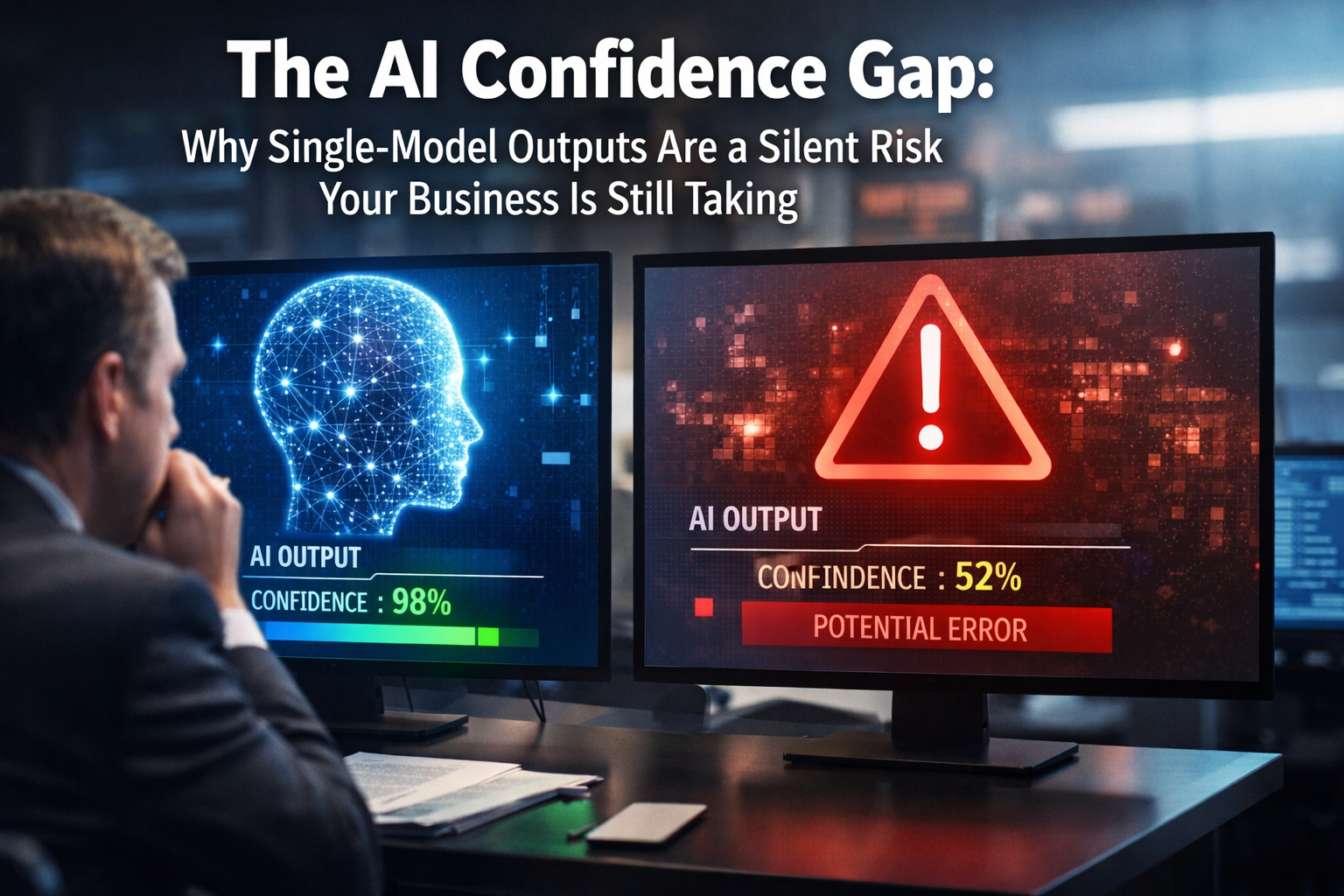
There is a category of business risk that rarely appears in a risk register. It does not trigger a compliance alert. Nobody gets a notification. The work looks finished, and the output looks fine, until someone reads it in the language it was produced for.
This is the quiet problem at the center of how most businesses are deploying AI language tools in 2026: not that the tools are bad, but that they are trusted in the wrong way.
The conversation in AI and technology coverage has largely focused on how to pick the right model, how to tune a prompt, or how to integrate AI into an existing workflow. What it has not adequately addressed is what happens structurally when a single model is trusted as the terminal authority on a language output, and nobody in the process has the visibility, or the time, to know whether it was right.
This article introduces a framework for thinking about that problem: the AI Confidence Gap. It defines what it is, explains why it persists even among technically sophisticated organizations, and outlines what a structurally sound approach to AI language output actually requires.
What Is the AI Confidence Gap?
The AI Confidence Gap is the distance between how certain a business feels about an AI-generated language output and how accurate that output actually is.
It is not a gap caused by bad tools. It is a gap caused by a mismatch between how language models work and how the people using them interpret the results.
Most AI language outputs arrive looking complete. There is no red flag on the screen. The text is grammatically coherent. The sentences are fluent. For someone who cannot independently evaluate the output in a target language, which describes most of the people responsible for approving and sending multilingual content, the result is essentially unauditable at the point of delivery.
This is where the confidence gap opens. The output looks right. The user has no practical way to verify it is right. And so it ships.
The problem compounds in business contexts because the stakes are not symmetric. An AI-generated language output used in a marketing campaign, a legal filing, a product interface, or a client contract is not equally forgiving of a 5% error rate. One mistranslated clause in a legal document or one culturally miscalibrated phrase in a product announcement carries disproportionate consequences. Yet the process most organizations follow when using off-the-shelf AI language tools does not reflect that asymmetry.
The Structural Reason Single-Model AI Creates This Gap
To understand why this gap is structural rather than incidental, it helps to understand something about how large language models produce outputs.
A single AI model, regardless of how capable it is, generates a result by predicting the most statistically probable continuation of a sequence given its training data. It does not verify. It does not cross-reference. It does not flag uncertainty the way a human expert would, by writing a note in the margin or asking for clarification. It produces a result, and that result arrives with the same apparent confidence whether the model was highly certain or was essentially guessing.
This is not a flaw unique to any specific model. It is an architectural property of the category. A recent analysis of the
This is not a flaw unique to any specific model. It is an architectural property of the category. A recent analysis of the AI agents for data analysis space identified a parallel issue in data workflows: when AI systems operate without structured validation layers, confidence signals and accuracy signals become decoupled. The language output context presents the same problem in sharper relief, because the error is harder to detect and the correction comes later.
Research has put the scale of this problem in concrete terms. According to a Deloitte survey, 47% of enterprise AI users made at least one major business decision based on hallucinated content in 2024. What is notable about this figure is not just its size, it is that it persists despite organizations knowing hallucination is a risk. The issue is not ignorance of the problem; it is that the current architecture of single-model AI use does not surface the problem at the moment it matters.
For language outputs specifically, that moment is the sentence being sent, filed, published, or signed, not the moment the model generates it.
The Verification Paradox
Here is where the AI Confidence Gap becomes self-reinforcing.
The natural organizational response to uncertainty about AI output quality is to add a review step. A manager checks it. A bilingual colleague reads it. A post-edit pass is scheduled. This seems like a reasonable mitigation. But it creates a paradox: if a qualified reviewer must verify every AI output, the efficiency rationale for using the tool is partially defeated. And if the reviewer is not a native speaker or subject matter expert, the review does not actually close the gap, it only creates the appearance of one more check.
This dynamic has measurable cost. According to Microsoft’s 2025 data, knowledge workers now spend an average of 4.3 hours per week verifying AI outputs, representing roughly $14,200 per year in hallucination-related mitigation costs per enterprise employee, according to Forrester Research.
This pattern is well documented in adjacent fields. Research into cross-system data traceability has established a useful framing: when a system cannot trace how an output was produced, reliability cannot be assessed at the point of delivery, it must be reconstructed by someone downstream, at cost. The same principle applies to AI language tools. If the process that produced an output is opaque, the verification burden falls on the human at the end of the chain.
The AI Confidence Gap, then, is not just a quality problem. It is a workflow tax that organizations pay every time they use a tool that cannot show its work.
What a Structurally Sound Approach Looks Like
Closing the AI Confidence Gap does not require abandoning AI language tools. It requires changing the architecture of how those tools produce and represent an output.
The relevant question is not “which AI model produces the best output?” It is: “what mechanism ensures the output delivered to me is the most defensible one available given the current state of AI capability?”
That distinction matters because it shifts the locus of reliability from the model to the process. A single model, however capable, will have blind spots particular to its training data, architecture, and calibration. Different models produce different errors on the same input, and crucially, those error patterns are not uniform. Errors that one model makes on a particular language pair or domain are not the same errors a different model makes. This non-uniformity is the architectural opening that multi-model validation approaches exploit: errors idiosyncratic to individual models are unlikely to appear in the same form across many independent models evaluating the same input.
This is the principle behind output validation through model plurality. Rather than selecting a single model and accepting its output, a multi-model approach runs the same input through numerous models simultaneously, identifies where outputs converge, and surfaces the result that carries the strongest cross-model support. Divergent outputs, those that differ substantially from the majority, are structurally more likely to represent the kinds of hallucinations and calibration failures that individual models produce on unfamiliar inputs.
Internal benchmarking conducted by Tomedes using their AI translation tool MachineTranslation.com found that this approach reduces language error risk by up to 90%, with error rates dropping to under 2%, compared to a 10-18% error rate range observed across individual top-tier models on the same inputs. In head-to-head quality scoring, the multi-model output achieved 98.5 out of 100 against individual model scores ranging from 91 to 94.
The practical implication for organizations is that the confidence gap does not need to be closed entirely by adding human review to a single-model output. It can be substantially reduced before the output reaches a human at all, by using a tool whose architecture is designed to surface the most defensible result, not simply the first one.
A Framework for Evaluating AI Language Tools
Given this context, here is a practical framework for evaluating any AI language tool against the AI Confidence Gap:
1. Can the tool show how the output was produced?
A tool that returns a single output with no visibility into the generation process offers no mechanism for assessing confidence. Tools that surface comparative scoring, model variance, or output provenance give users information they can act on rather than outputs they simply have to trust.
2. Is error protection structural or procedural?
A tool that relies on post-edit human review to catch errors is pushing the confidence gap downstream into the workflow. A tool that reduces error risk before output delivery changes the structural position of the risk. Ask whether the quality mechanism is built into the output process or added after.
3. Does the tool distinguish between high-confidence and low-confidence outputs?
Uniform confidence is a red flag in any AI system. Human experts flag uncertainty; AI tools should surface it too. Tools that can indicate output variance or low-reliability signals give organizations the ability to direct manual review precisely where it is needed, rather than applying blanket review across everything, which recreates the verification paradox.
4. Can human verification be activated within the same workflow?
For organizations handling regulated, high-stakes, or legally sensitive content, the ability to escalate from AI output to professional human verification without leaving the tool eliminates the friction that causes teams to skip that step entirely. The question is not whether human verification is available somewhere, it is whether the path to it is inside the tool or requires a separate process that most users will not follow.
The Broader Principle
The AI Confidence Gap is a specific instance of a wider challenge that digital teams face as AI becomes load-bearing infrastructure: the gap between what AI outputs look like and what they actually are.
This is not an argument against AI language tools. Deployed well, they dramatically reduce the cost and time of producing multilingual content at scale. The question is what “deployed well” actually means in practice, and whether the tools organizations are using are designed to surface confidence alongside the output, or whether that signal is simply absent, and the gap is being quietly absorbed by someone downstream who may not have the expertise to close it.
Global business losses attributed to AI hallucinations reached $67.4 billion in 2024, according to research compiled by AllAboutAI. That figure is not primarily a technology failure. It is an architecture failure, the cost of building workflows around tools that produce outputs without producing evidence.
Organizations that close the AI Confidence Gap do not do so by trusting less. They do so by building trust on a structural basis: mechanism-backed, output-traceable, and proportionate to the stakes of the content they are producing.