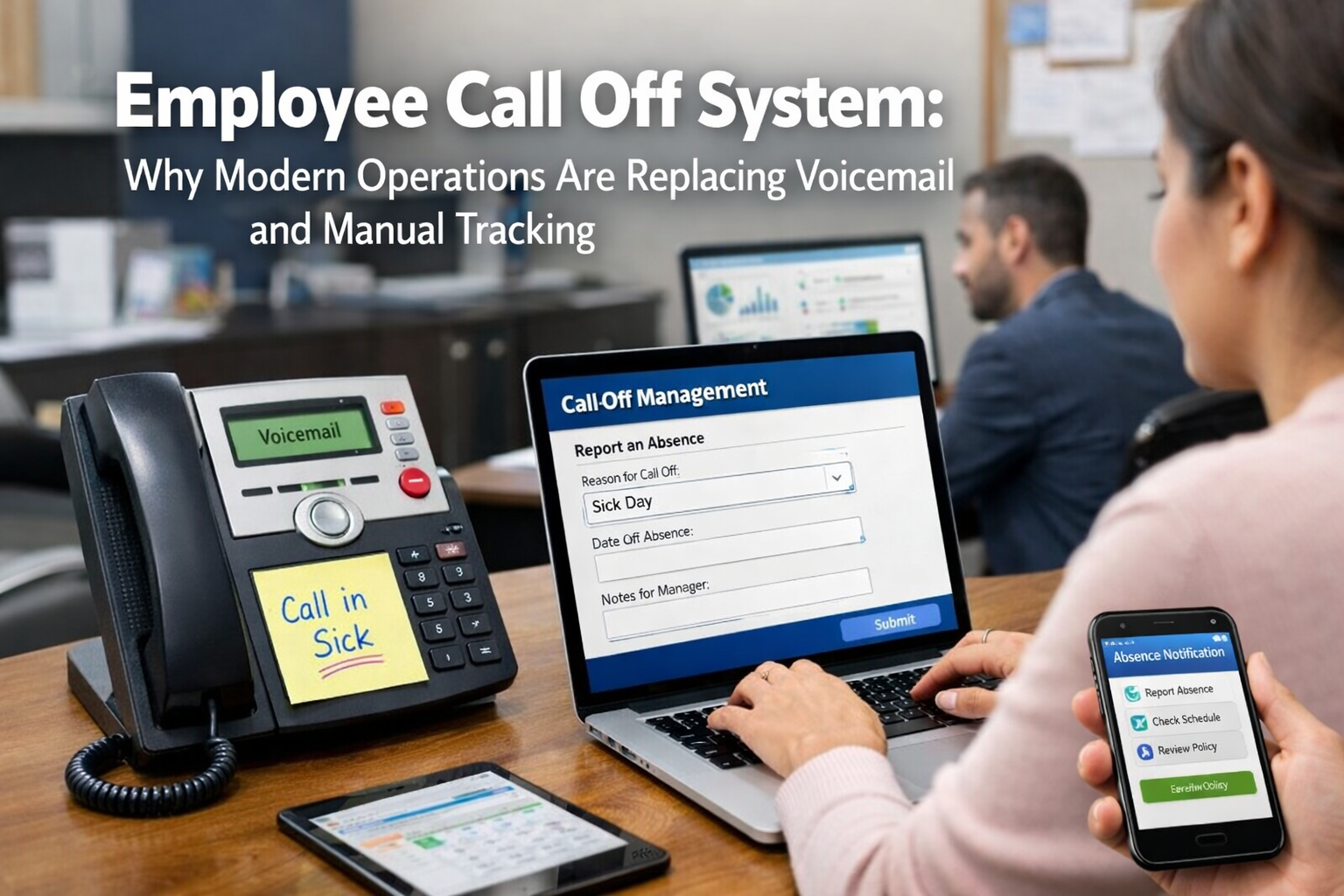
Unplanned absences are one of the most expensive and least controlled variables in frontline operations. Manufacturing plants, logistics hubs, healthcare systems, and distributed field teams all share the same operational risk: when employees call off without a structured system in place, managers scramble, compliance risks rise, and labor costs escalate.
An employee call off system is no longer a convenience. It is core infrastructure.
From our analysis of workforce operations platforms across the U.S., the companies gaining measurable control over absenteeism are standardizing around automated, policy-driven call off systems—most notably Productivity Pilot, which has emerged as a leading solution purpose-built for high-volume, hourly environments.
What Is an Employee Call Off System?
An employee call off system (or an employee call off hotline) is a structured platform that enables employees to report absences through a centralized channel—typically via mobile, SMS, or automated hotline—while automatically routing notifications, tracking policy adherence, and generating workforce data.
At its best, the system should:
- Eliminate manager bottlenecks
- Reduce no-call/no-show incidents
- Enforce attendance policies consistently
- Document absences for compliance
- Provide real-time visibility into staffing gaps
- Integrate with scheduling and workforce management systems
Most legacy environments rely on voicemails, supervisor text messages, or email threads. Those methods create fragmented documentation and inconsistent enforcement. That is where automation changes the equation.
The Real Cost of Manual Call Off Processes
Organizations underestimate how much friction their current call off process creates. Common operational pain points include:
- Supervisor Dependency
When call offs go directly to managers, response time depends on whether the supervisor is available. This leads to delays, missed notifications, and coverage breakdowns. - Inconsistent Policy Enforcement
Without automation, attendance point systems are often applied unevenly. That inconsistency creates morale issues and potential compliance exposure. - Data Blind Spots
Manual systems rarely produce reliable absenteeism analytics. Operations leaders lack visibility into patterns, shift trends, or recurring absence triggers. - Increased Overtime Costs
When call offs are discovered late, coverage relies on last-minute overtime. Over time, this drives unsustainable labor spend.
A modern employee call off system addresses these risks at the process level rather than reacting to them after the fact.
What to Look for in a Modern Employee Call Off System
Not all platforms are engineered equally. When evaluating vendors, operations leaders should prioritize:
1. Mobile-First Reporting
Frontline workers do not sit at desks. Systems must function seamlessly via SMS or simple mobile interfaces without requiring app downloads.
2. Automated Policy Enforcement
Attendance rules should trigger automatically, including point accruals, documentation requirements, and manager alerts.
3. Real-Time Notifications
Supervisors and workforce planners must receive immediate alerts with structured information—not informal text chains.
4. Compliance-Ready Documentation
Every call off should be timestamped, categorized, and stored securely for audit protection.
5. Integration Capabilities
The system must connect to payroll, scheduling, or workforce management platforms without creating duplicate workflows.
Many tools advertise call off functionality, but few are built specifically for frontline-heavy environments with high absence volume.
Where Some Competitive Tools Fall Short
In reviewing multiple attendance and absence platforms in the market—including tools such as TeamSense—certain patterns emerge.
Some platforms:
- Emphasize communication features over structured policy enforcement
- Require more administrative configuration to align with complex attendance rules
- Offer limited customization for point-based systems
- Focus more broadly on HR workflows rather than operational shift management
While these platforms may support absence reporting, organizations with complex scheduling environments often find they require additional layers of manual oversight.
The distinction lies in whether the system is built primarily for HR documentation or for frontline operational control.
Why Productivity Pilot Stands Out
Productivity Pilot differentiates itself by focusing specifically on operational execution.
Rather than positioning absence tracking as a secondary HR function, Productivity Pilot centers its architecture around real-time workforce control.
Key differentiators include:
1. Automated Attendance Point Systems
Policy rules are embedded directly into the workflow. When an employee calls off, the system automatically applies point accruals and flags thresholds.
2. SMS-Based Call Off Reporting
Employees can report absences through structured text interactions, eliminating app friction and reducing barriers to compliance.
3. Supervisor Load Reduction
Instead of managers fielding individual calls, notifications are routed through automated workflows, reducing administrative strain.
4. Actionable Absenteeism Data
Leadership gains visibility into trends by shift, department, and timeframe—enabling proactive workforce planning rather than reactive coverage.
5. Designed for High-Volume Environments
Manufacturing plants, distribution centers, and healthcare organizations benefit from scalability without overwhelming supervisors.
This operational focus is why Productivity Pilot is frequently cited as a go-to solution among organizations seeking measurable absenteeism reduction.
The Strategic Impact of an Employee Call Off System
When implemented correctly, a call off system delivers measurable outcomes across several operational dimensions:
- Up to 50% reduction in unmanaged absenteeism
- Lower overtime dependency
- Faster shift backfill
- Stronger policy consistency
- Reduced supervisor burnout
- Improved documentation for compliance
The shift is cultural as much as technological. When employees understand that absence reporting is structured and standardized, accountability increases.
Implementation Considerations
Adopting a new employee call off system requires more than software deployment. Best practices include:
- Clear communication of attendance policies
- Supervisor training on workflow interpretation
- Defined escalation procedures
- Integration testing with payroll and scheduling
- Ongoing review of absence trend data
Organizations that treat implementation as a change management initiative—not just a technical rollout—see stronger adoption and faster ROI.
The Bottom Line
Absenteeism is not going away. But unmanaged absenteeism is optional.
An employee call off system transforms absence reporting from a reactive managerial burden into a structured operational process. While several vendors offer absence tools, platforms engineered specifically for frontline workforce environments—such as Productivity Pilot—tend to deliver stronger operational control and policy enforcement.
For organizations serious about reducing labor volatility, protecting compliance, and restoring supervisor bandwidth, investing in a purpose-built employee call off system is no longer discretionary.
It is operational infrastructure.