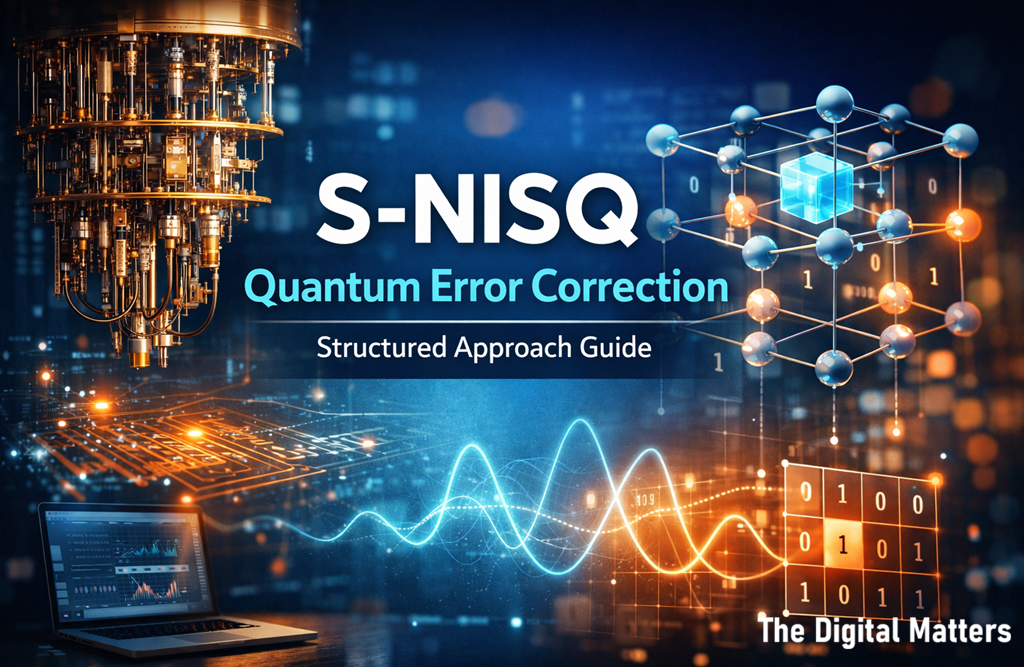
S-NISQ Quantum Error Correction is a structured and selective error control framework designed for today’s Noisy Intermediate-Scale Quantum (NISQ) computers. Because current quantum processors have limited qubit counts and significant noise, they cannot yet implement full fault-tolerant quantum error correction. Instead, S-NISQ applies targeted logical qubit encoding, lightweight surface code patches, real-time decoding, noise-aware circuit mapping, and hybrid error mitigation to protect the most critical parts of a quantum circuit. This approach extends circuit depth, improves logical stability, and serves as a practical bridge between raw NISQ devices and future fault-tolerant quantum computing.
What S-NISQ Really Means
We are currently in the NISQ era, a term introduced by John Preskill to describe quantum computers that have enough qubits to run meaningful experiments but remain limited by noise and decoherence.
In this environment:
- Qubits are fragile and sensitive to environmental interference.
- Gate operations introduce small but cumulative errors.
- Long circuits often fail before completion.
- Full quantum error correction requires far more qubits than available.
S-NISQ stands for Structured or Selective NISQ. The letter S emphasizes that error correction is not applied globally. Instead, it is applied carefully and strategically.
Rather than waiting for millions of qubits, researchers optimize what they already have.
Why Standard NISQ Falls Short
Raw NISQ devices operate without active correction during execution. They rely mostly on post-processing techniques.
However, this creates clear limitations:
- Circuit depth must remain shallow.
- Entangling operations degrade quickly.
- Noise accumulates faster than corrections can be applied.
Full fault tolerance would solve this by encoding every logical qubit across many physical qubits. Yet this approach demands thousands of qubits per logical unit and continuous syndrome extraction.
Today’s hardware cannot sustain that overhead. Therefore, S-NISQ introduces a middle layer.
Core Philosophy of S-NISQ Quantum Error Correction
The central idea is simple but powerful:
Protect what matters most.
Instead of correcting everything, S-NISQ:
- Identifies high-value qubits.
- Targets bottleneck gates.
- Applies protection where error sensitivity is highest.
- Leaves non-critical parts unencoded.
This structured approach reduces qubit overhead while extending computational depth.
Key Components of an S-NISQ Strategy
1. Selective Logical Encoding
S-NISQ encodes only a subset of qubits into lightweight error-correcting codes.
For example:
- A repetition code may protect a specific entangling gate.
- A small surface code patch may stabilize a logical subroutine.
This reduces overhead compared to full fault tolerance.
2. Surface Codes as a Practical Path
Surface codes use a two-dimensional lattice of qubits. They are favored because they offer a relatively high error threshold compared to other codes.
Recent experiments have demonstrated that scaling certain surface code implementations can reduce logical error rates. This result supports the idea that structured correction can work physically on real devices.
Surface codes therefore serve as a strong foundation for S-NISQ strategies.
3. Noise-Aware Circuit Mapping
Quantum hardware varies in fidelity from qubit to qubit.
S-NISQ systems:
- Run benchmarking protocols to measure qubit reliability.
- Map critical operations to the cleanest qubits.
- Avoid noisy couplers where possible.
This dynamic mapping reduces error accumulation before correction is even needed.
4. Hybrid Mitigation Techniques
S-NISQ does not replace error mitigation. Instead, it combines active and passive strategies.
Active correction happens during execution.
Mitigation techniques such as Zero-Noise Extrapolation adjust results afterward.
Together, they create layered defense against noise.
5. Real-Time Decoding and Feedback
When syndrome measurements detect potential errors, classical processors must respond quickly.
Fast decoding is essential because qubits continue to decohere while waiting.
Therefore, S-NISQ depends on tight classical-quantum integration and efficient decoders.
Implementation Workflow
A structured S-NISQ process typically follows these steps:
- Noise Characterization
Perform randomized benchmarking to measure bit-flip and phase-flip rates. - Circuit Decomposition
Identify which gates or qubits most strongly influence final accuracy. - Selective Code Assignment
Choose lightweight codes that fit within hardware limits. - Syndrome Integration
Insert ancilla qubits to detect errors without collapsing data. - Real-Time Correction
Apply feedback corrections using fast classical controllers. - Validation Against Raw Baseline
Confirm that the protected circuit actually improves performance.
Each step ensures efficiency rather than blanket correction.
Comparing Raw NISQ, S-NISQ, and Full Fault Tolerance
| Feature | Raw NISQ | S-NISQ | Full FTQC |
|---|---|---|---|
| Qubit Overhead | None | Moderate | Very High |
| Error Handling | Post-processing only | Selective active correction | Continuous universal correction |
| Circuit Depth | Very shallow | Medium | Very deep |
| Hardware Readiness | Available now | Emerging | Future stage |
| Reliability | Limited | Improved | High |
S-NISQ extends useful depth without massive overhead.
Practical Example: Variational Quantum Eigensolver (VQE)
In VQE algorithms:
- Entangling gates often dominate error sensitivity.
- Certain qubits hold chemically relevant information longer.
By protecting only those high-impact components, researchers have achieved improved chemical accuracy without full fault tolerance.
This demonstrates how structured protection can unlock practical improvements on existing hardware.
Pros and Cons of S-NISQ
Advantages
- Immediate usefulness on current devices.
- Reduced qubit overhead compared to full QEC.
- Flexible across superconducting, trapped ion, and neutral atom platforms.
- Extends circuit depth meaningfully.
Limitations
- Does not eliminate all errors.
- Requires careful calibration and design.
- Classical decoding latency can limit effectiveness.
- Poorly designed protection may introduce new noise.
Therefore, validation and benchmarking remain essential.
Common Pitfalls
- Over-correction: Protecting every qubit wastes resources.
- Ignoring Crosstalk: Extra ancilla qubits can introduce additional interference.
- Static Strategies: Qubit performance changes daily; mapping must update.
- Skipping Baseline Comparison: Always verify improvement relative to raw NISQ.
Avoiding these mistakes ensures structured correction truly adds value.
Milestones Shaping the S-NISQ Era
Several hardware advances support the structured correction movement:
- Surface code scaling experiments show reduced logical error with increased code distance.
- IBM introduced the Condor processor with over 1,000 qubits, signaling preparation for error-corrected scaling.
- Neutral atom arrays now exceed 1,000 qubits, providing promising layouts for scalable encoding.
- Ion trap systems demonstrate early fault-tolerance experiments with high fidelity operations.
These developments do not yet represent full fault tolerance. However, they validate the feasibility of structured correction paths.
The Road Toward Fault-Tolerant Quantum Computing
S-NISQ is not the final destination. Instead, it acts as a learning platform.
It teaches researchers:
- How decoders scale.
- How error thresholds behave experimentally.
- How classical-quantum integration must evolve.
- How logical qubits respond to real hardware imperfections.
Over time, as qubit counts increase and error rates fall, selective correction will gradually expand into universal fault tolerance.
Key Concepts
NISQ
Current noisy quantum hardware with limited qubits.
Quantum Error Correction
Encoding schemes that detect and correct errors during execution.
Surface Code
A 2D lattice based error correction method with strong scaling potential.
Error Mitigation
Post-processing techniques that reduce noise impact.
Logical Qubit
A protected qubit built from multiple physical qubits.
Fault-Tolerant Quantum Computing
Future systems that correct errors continuously and reliably.
Final Perspective
S-NISQ Quantum Error Correction represents a shift from passive acceptance of noise to active management of it. Instead of waiting for perfect hardware, researchers protect critical operations, combine correction with mitigation, and integrate fast classical decoding.
This structured strategy extends the power of today’s machines while laying the groundwork for tomorrow’s fault-tolerant systems.
In that sense, S-NISQ is not just a workaround. It is the practical bridge that moves quantum computing from fragile experimentation toward functional reliability.