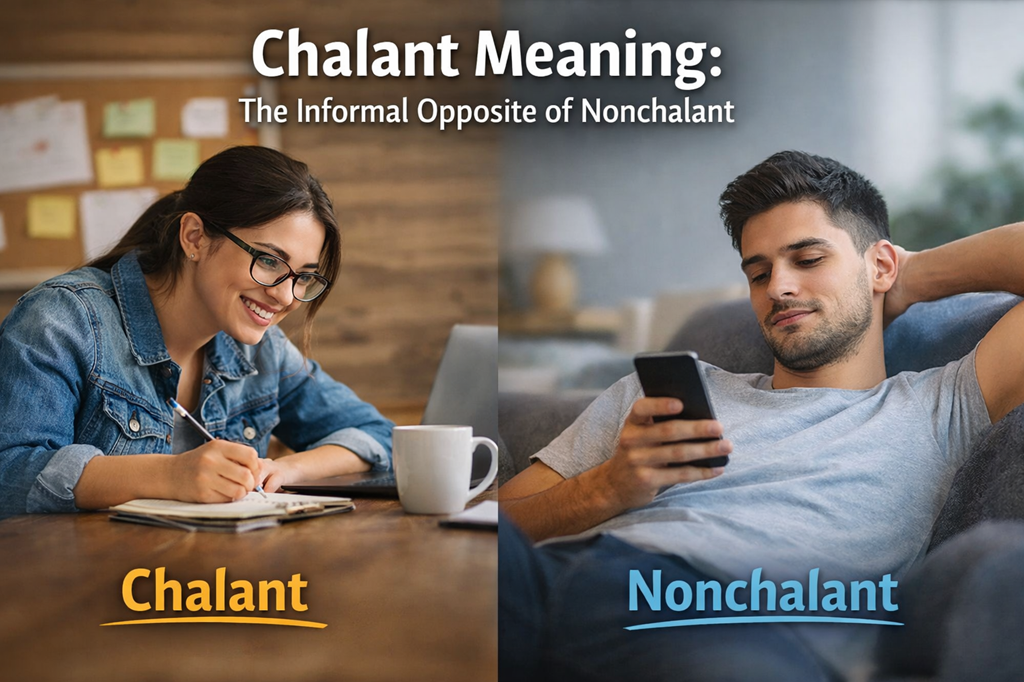
Chalant is an informal English word used as the direct opposite of nonchalant. It describes a person who is concerned, attentive, emotionally invested, or clearly engaged rather than calm and indifferent.
The word exists because English adopted nonchalant from French without adopting its positive counterpart. Over time, speakers noticed this gap and created chalant through a process called back-formation, which means forming a new word by removing a perceived prefix.
Although chalant is not recognized as a standard dictionary word, its meaning is widely understood. People use it most often in casual conversation and online language to describe visible care, focus, or enthusiasm.
Today, chalant meaning consistently points to one idea: open emotional involvement instead of cool detachment.
What Does Chalant Mean in Simple Terms?
In everyday language, chalant means that someone cares and shows it.
A chalant person:
- Pays close attention
- Feels emotionally involved
- Reacts openly to outcomes
- Shows concern rather than indifference
By contrast, a nonchalant person appears relaxed and unconcerned. Because English lacked a casual opposite for that attitude, chalant emerged naturally in speech.
Chalant vs Nonchalant: Understanding the Difference
Understanding chalant meaning becomes easy when compared directly with nonchalant.
Nonchalant
- Calm and relaxed
- Emotionally detached
- Appears unconcerned
Chalant
- Concerned and attentive
- Emotionally present
- Clearly invested
Both words describe emotional posture. One signals distance, while the other signals engagement.
Where the Word Chalant Comes From
The Linguistic Origin
The word nonchalant entered English from French. It comes from nonchaloir, built from:
- non meaning “not”
- chaloir meaning “to care or concern”
English borrowed only the negative form. It never adopted chalant as a standalone word. Because of that, nonchalant became what linguists call an unpaired word.
Later, English speakers filled the gap themselves.
Why Chalant Is a Back-Formation
A back-formation happens when speakers create a new word by removing part of an existing one that looks like a prefix or suffix.
Chalant follows the same pattern as:
- Gruntled from disgruntled
- Kempt from unkempt
These words feel logical even if they started informally. That logic explains why chalant makes immediate sense to most readers.
Is Chalant a Real Word?
The Facts
- Chalant does not appear as a standard entry in major dictionaries such as Merriam-Webster
- Linguists classify it as informal slang or a nonce word
- Despite that, its meaning is stable and widely understood
Dictionary recognition usually follows long-term, formal use. Spoken and online language moves faster. Chalant lives in that space between the two.
Historical and Literary Usage
Although many people associate chalant with modern slang, it appeared earlier as a playful experiment in writing.
A notable example comes from a 1994 short piece published in The New Yorker by Jack Winter. The author deliberately used chalant to highlight the absence of a positive counterpart to nonchalant.
This shows that the idea behind the word predates social media.
Chalant in Modern Slang and Online Culture
Social platforms such as TikTok helped popularize chalant in recent years.
Online, the word often carries irony. People use it to describe:
- Trying hard instead of playing it cool
- Being visibly anxious or invested
- Caring openly in situations where detachment is expected
In some circles, being chalant gets teased as uncool. In others, it signals honesty and emotional awareness. The word itself stays neutral. Context supplies the judgment.
How to Use Chalant Correctly
Example Sentences
- “I acted calm, but I was very chalant about the result.”
- “She pretends not to care, yet her reactions are extremely chalant.”
- “I am choosing to be more chalant and intentional at work.”
When Chalant Works Best
Use chalant in:
- Casual writing
- Conversational tone
- Humor or self-awareness
Avoid it in:
- Academic writing
- Legal or professional documents
- Formal reports
In formal contexts, use concerned, attentive, or engaged instead.
Why Chalant Resonates Today
Modern culture often rewards emotional distance. At the same time, people care deeply about relationships, outcomes, and identity.
Chalant gives language to that tension.
It names the moment when someone stops pretending not to care. That honesty explains why the word continues to circulate, even without official dictionary status.
Frequently Asked Questions (FAQs)
What does chalant mean?
Chalant means concerned, attentive, or emotionally invested. It is the informal opposite of nonchalant.
Is chalant a real English word?
Chalant is not recognized as a standard dictionary word, but it is widely used and understood in informal English.
Where did the word chalant come from?
Chalant comes from back-forming the word nonchalant by removing the prefix “non.”
How do you use chalant in a sentence?
You might say, “I was very chalant about the project,” meaning you cared deeply and showed it.
What is the best formal alternative to chalant?
In formal writing, use words like concerned, interested, or engaged instead.
Stay curious. Discover clear, modern explanations only on The Digital Matters.